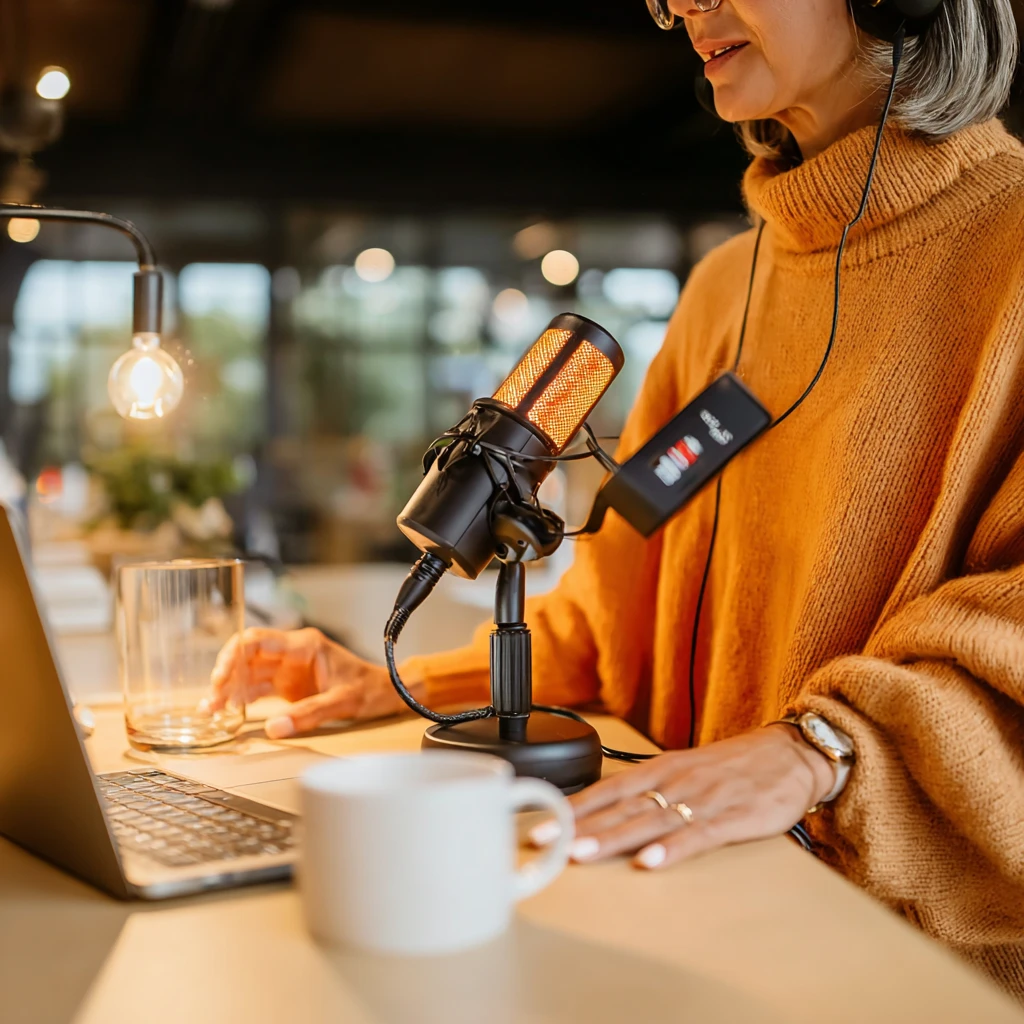
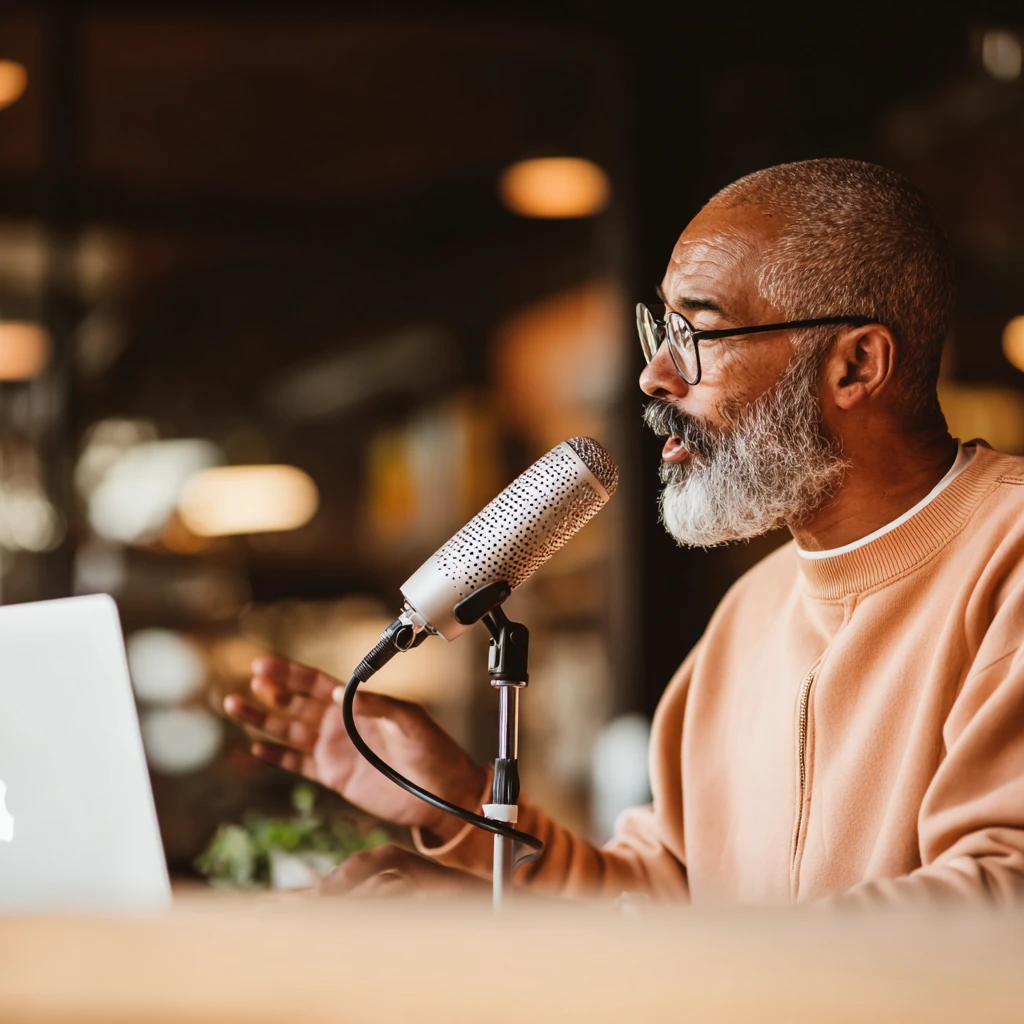
Most people never think about the voice behind interpreting. During an event, the interpreter’s voice simply becomes part of the experience. The audience sees the speaker, hears a voice delivering meaning in their own language, and instinctively understands the relationship between the two.
A male presenter may be interpreted by a female interpreter, or vice versa. Audience participants do not expect voice matching, because the priority is on clarity, not impersonation.
But as interpreting moves into digital and hybrid formats, this dynamic is changing. AI voices, streamed sessions, and on-demand content bring voice into the spotlight; creating new expectations around consistency, identity, and authenticity.
This is where things get interesting.

Traditional interpreting: A human voice working behind the scenes
Human interpreters focus on accuracy, intent, and cultural nuance; not on sounding like the speaker. They don’t match pitch, cadence, or personality, because interpreting is a real-time transfer of meaning, not a performance.
Audiences intuitively recognise the human element behind traditional interpreting. Interpreters are chosen for their language expertise, cultural understanding, and ability to convey meaning in real time; not because they sound like the speaker. Whether the interpreter is physically present or not, listeners understand that he or she is a separate professional.
What audiences do expect, however, is stability. In some cases, interpreters may rotate in shifts. Voices changing mid-session can be confusing, especially if there are multiple speakers, and multiple voices behind them. With rotating interpreters, the listener must re-orient, and it can become harder to follow who is speaking.
Even when the interpretation stays correct, the change in voice adds to the cognitive, or mental, load on audience participants.
In human interpreting, voice matching isn’t expected; but voice stability is.
People expect more from AI interpreting
AI interpreting uses digital voices to deliver real-time translation. These voices are:
consistent
clear
easy to follow
emotionally neutral
not tailored to individual speakers
This consistency makes AI interpreting highly effective in structured or turn-based communication.
But it also makes the voice more noticeable.
A speaker may be interpreted into a voice that doesn’t match their gender, energy level, or expressive style. Unlike human interpreting, where mismatch feels normal, AI mismatch stands out.
Why? Because we are used to full control over AI
Audiences increasingly assume that anything powered by AI should be fast, flexible, and fully customisable – also for AI interpreting even though it is still an emerging technology.
In many professional tools, users already customise AI outputs: they choose tones in writing assistants, refine transcripts instantly, or adjust the style of AI-generated content. These everyday interactions teach audiences that AI-powered tools can adapt their output on demand.
As a result, this means listeners often expect AI interpreting to match the speaker’s identity, tone, or style, simply because other AI tools offer that level of control.
Audiences assume a higher degree of personalisation, even in live interpreting scenarios where such customisation isn’t technically realistic.
As a result, when AI interpreting is used in real time, people expect the voice to “fit” the speaker more closely, even though interpreting has never required this.
And when voice is recorded, we expect even more
These expectations become even higher once the event is recorded.
The moment that same live event becomes a recording, people see the video as a professional and polished product – not as a recorded event – and in turn, they expect even better production value and sound quality.
See how AI Interpreting worksWhat happens when multiple speakers are involved?
Most AI interpreting solutions use one voice per channel.
This means that there will only be one voice, even if there are multiple speakers, like in a panel or roundtable. While it excels at stability, AI cannot distinguish between multiple speakers.
This becomes most noticeable in:
fireside chats
debates
multi-presenter events
customer interviews
town halls with shifting speakers
emotionally or stylistically varied content
Even with human interpreting, changes in voice can create mild confusion, but these shifts are usually predictable and can be managed through planning. When you understand the rotation patterns or assign interpreters strategically to different speakers, the audience can adjust and maintain continuity.
With AI interpreting, the challenge is different. Because the voice never changes, the audience loses all speaker differentiation entirely. A panel or debate that feels dynamic in the source language can become flat or harder to follow in the interpreted channel.
When speaker distinction matters, humans still deliver the most natural and intuitive listening experience.
Emotion, intent, and tone: Where AI interpreting reaches its limits
Interpreting isn’t acting, but tone matters.
Human interpreters adjust delivery automatically as a speech or presentation evolves. They can add urgency, soften for sensitive content, or build energy as the speaker crescendos.
AI interpreting does not. A digital voice remains steady and neutral throughout.
AI can accurately deliver the message, but not the shifting tone that often makes the message land.
This limitation matters most in:
keynotes that build momentum
investor updates with subtle emphasis
crisis communication
persuasive or creative presentations
emotionally charged messages
However, AI interpreting performs extremely well in structured settings:
webinars
product demos
training
onboarding
internal updates
one-speaker at a time formats
Stability becomes a strength where tonal variation is less critical.
Learn more about our Interpreting SolutionsDubbing and voiceover: Different format, different expectations
As explained earlier, once an event lives on as a recording, people suddenly have a different expectation of the voice used (and the quality).
This is why AI interpreting used in live contexts can feel out of place when replayed as recorded content.
At this point, dubbing or voiceover often becomes the more appropriate choice, allowing the recorded version to match the speaker’s style, tone, and intended audience experience.
However, expectations also depend on format, channel, and purpose. Let's take an on-demand version of a webinar. Listeners will understand that this is a webinar and adjust their expectations accordingly.
It's another story when clips from that same webinar are repurposed for marketing and social media content or other customer-facing videos. In those cases, voice quality, tone alignment, and overall polish become much more important and the audience benchmark shifts closer to what they associate with professional video or audio production.
This is where the choice between AI dubbing, human dubbing, or voiceover depends on the intersection of your quality expectations, the audience and channel, how polished the content needs to sound, and your available budget and timeline.
Each option provides a different balance of clarity, emotionality, and production value. Understanding where your content sits on this spectrum helps determine the most appropriate approach.
When to choose human interpreting, AI interpreting, or dubbing
Here’s the simplest framework:
Choose human interpreting when:
speaker identity matters
multiple speakers need distinct voices
nuance is critical
the content is high-stakes or emotional
the format is interactive
Choose AI interpreting when:
the format is structured
clarity and consistency matter
you need multiple languages at scale
cost or logistics are a concern
the event is digital or hybrid
Choose AI dubbing or voiceover when:
the content is recorded
voice alignment improves the experience
you need scalable multilingual training
consistency across languages is essential
Bringing it all together: Voice shapes experience, no matter the technology
The voice your audience hears shapes your message; whether it’s a live interpreter, an AI interpreting voice, a dubbing artist, or a digitally generated narrator. Each has its place. The key is choosing the right one for the right moment.
Need help finding the right voice for your content? Whether you’re planning a live event, hybrid meeting, or creating multilingual recordings, we can help you choose the approach that fits your goals, audience, and budget.
Talk to our experts.Want more insights like this?
This article was first published in our quarterly newsletter. If you’d like more thoughts on interpreting, AI, localisation, and language, sign up to our newsletter and get expert insights straight to your inbox.
Sign up for more like thisLet’s build the right interpreting solution for you
Your journey to clear, real-time multilingual communication starts here. Tell us about your needs, and we’ll tailor an interpreting solution that fits your workflows, audience, and enterprise goals.